Bloom filters: 'definitely not' or 'maybe'
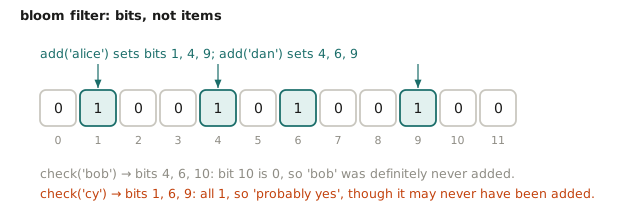
A Bloom filter answers 'have I seen this item?' using very little memory, at the price of occasional mistakes in one direction. It's a bit array, all zeros at the start, plus k hash functions. To add an item, hash it k times and set those k bits to 1. To check an item, hash it the same way: if any of its bits is 0, it was definitely never added. If all are 1, it was probably added.
The 'probably' is because other items may have set those same bits. So a Bloom filter can give false positives but never false negatives. It can't list its items, and plain Bloom filters can't delete them (clearing a bit could erase another item).
Databases like Cassandra and RocksDB keep a Bloom filter per data file on disk: before reading a file to look for a key, they ask the filter, and skip the read when the answer is 'definitely not'. Most lookups for missing keys never touch the disk.
In code: Python · Rust
import hashlib
class Bloom:
    def __init__(self, m=1024, k=3):
        self.m, self.k, self.bits = m, k, bytearray(m)
    def _idx(self, item):
        for i in range(self.k):
            h = hashlib.sha256(f"{i}:{item}".encode()).digest()
            yield int.from_bytes(h[:8], "big") % self.m
    def add(self, item):
        for i in self._idx(item): self.bits[i] = 1
    def maybe_contains(self, item):
        return all(self.bits[i] for i in self._idx(item))
use std::collections::hash_map::DefaultHasher;
use std::hash::{Hash, Hasher};
struct Bloom { bits: Vec<bool>, k: u64 }
impl Bloom {
fn idx<T: Hash>(&self, item: &T, i: u64) -> usize {
let mut h = DefaultHasher::new();
i.hash(&mut h); item.hash(&mut h);
(h.finish() % self.bits.len() as u64) as usize
}
fn add<T: Hash>(&mut self, item: &T) {
for i in 0..self.k { let j = self.idx(item, i); self.bits[j] = true; }
}
fn maybe_contains<T: Hash>(&self, item: &T) -> bool {
(0..self.k).all(|i| self.bits[self.idx(item, i)])
}
}- This sketch uses a byte or bool per bit for clarity; real filters pack 8 bits per byte.
- Libraries pick m and k from the expected item count and the false-positive rate you can accept.